This analytical essay contains extensive discussion of the film Vanilla Sky (2001), which includes depictions and themes related to vehicular homicide and suicide, severe facial disfigurement and trauma, murder and suffocation, mental illness and psychosis, substance use, sexual content and intimate partner violence, stalking and possessive behavior, as well as existential and psychological distress. The essay engages with these elements through the lenses of philosophy, mythology, psychoanalysis, and cultural criticism, and does not endorse or glorify violence, self-harm, or abusive behavior. Readers who may be sensitive to discussions of suicide, domestic violence, sexual assault, or severe bodily trauma are advised to proceed with awareness of their own emotional boundaries. The analysis is intended for mature audiences and should not serve as a substitute for professional mental health guidance or crisis support.
Introduction: The Mask as Mirror, The Face as Question
“The dream is the small hidden door in the deepest and most intimate sanctum of the soul, which opens to that primeval cosmic night that was soul long before there was conscious ego and will be soul far beyond what a conscious ego could ever reach.”
- Carl Gustav Jung
In the winter of 2001, between the wreckage of the dot-com bubble and the shadow of an approaching war, Cameron Crowe released a film that seemed designed to resist its own moment. Vanilla Sky was a lush, paranoid, romantic existential thriller dressed in the expensive clothing of Tom Cruise’s star persona - a remake of Alejandro Amenábar’s Spanish art-house film Abre los ojos (1997) that dared to replace the original’s spare, chilly dread with an American vocabulary of pop songs, celebrity faces, and metaphysical confusion. It arrived as a commercial proposition and functioned as a philosophical riddle, a meditation on guilt, beauty, disfigurement, and the architecture of waking life. Two decades later, it has become a cult object - not because its ambiguities were resolved, but because they proved inexhaustible. The film’s initial reception was brutal: a D- CinemaScore, mixed reviews, accusations of narcissism and incoherence. Roger Ebert gave it three stars but noted it required two viewings. Audiences walked out complaining that nothing made sense. But Vanilla Sky was never supposed to make sense in the way a thriller makes sense. It was supposed to make sense the way a dream makes sense - through condensation, displacement, symbolic overdetermination, and the terrifying logic of the unconscious.
The film opens with a scream and a question. David Aames Jr., heir to a publishing empire, wakes in a deserted New York City, drives through empty streets toward Times Square, and finds himself utterly alone. The city that never sleeps has fallen into a coma. Then he wakes again. This double beginning - dream within dream, false awakening layered upon false awakening - announces the film’s central preoccupation: the instability of reality as a category and the desperate human need to distinguish the true from the false. David wears a prosthetic mask throughout his framed narrative, hiding a face destroyed by a jealous lover’s suicide crash. But the mask is also a metaphor for the self itself - the persona (from the Latin for actor’s face) that conceals the wounded psyche beneath. In Roman theater, the persona was the mask through which an actor projected his role; in Jungian psychology, it is the social identity we present to the world, necessary for functioning but fatal if mistaken for the whole self. David Aames has made that mistake. Before his disfigurement, he was nothing but persona - charming, handsome, wealthy, empty. The crash strips the persona away, leaving him with the shadow - the repressed, guilty, frightened self he has never acknowledged. Vanilla Sky asks whether any face we present is ever more than a mask, and whether waking life might be only the most convincing layer of an infinitely regressive dream.
This essay will not separate summary from interpretation. Instead, it will unfold the film’s narrative as a series of philosophical and mythological tableaux, each event generating its own commentary, each gesture rippling outward into the total field of human culture - from Plato’s cave to Philip K. Dick’s scanner, from Orpheus and Eurydice to The Matrix and The Sopranos, from Gnostic cosmology to contemporary theories of consciousness, from the Upanishads to Jean-Paul Sartre’s nausea, from Beethoven’s late quartets to the glitch aesthetics of digital art. The argument proceeds in seven movements: the fall from grace (the car crash as original sin and narcissistic wound), the nightmare of substitution (the fusion of Sofia and Julie as a crisis of personal identity), the cryonic revelation (life extension as Gnostic trap and corporate eschatology), the rooftop choice (the leap as Kierkegaardian faith and Camusian rebellion), the open eye (consciousness as the irreducible ground of being), and finally, two intervening sections that expand the film’s cultural and philosophical resonances: the figure of the mask and prosthesis (the disfigured face as site of truth), and the function of music and sound (pop songs as psychic architecture). Within each section, narration and interpretation fuse into a single, dynamic mode of discourse, as if the story is being remembered and interpreted in the same mental breath.
Section One: The Fall from Grace - Privilege, Disfigurement, and the Car Crash as Original Sin
“For what is a man profited, if he shall gain the whole world, and lose his own soul?”
- Matthew 16:26, “The Gospel of Matthew”
David Aames Jr. lives a life designed to provoke the wrath of the gods, the envy of mortals, and the weary tolerance of psychoanalysts. He is the 51% owner of a major publishing house, inherited from parents who died in a car accident when he was young - a detail that already positions him as a kind of orphan-king, ruling without wisdom, a Hamlet without the ghost’s instruction. He sleeps with beautiful women while feeling nothing for them. He dismisses the board of directors as the “Seven Dwarfs,” a mockery that reveals his contempt for the structures of adult responsibility and aligns him with the fairy-tale logic of Snow White - except that David is not the prince but the witch, not the sleeping beauty but the tyrant who cannot wake. He throws lavish birthday parties where he wears a 1970s-style leisure suit and glides through rooms like a benevolent ghost, a Gatsby without the green light, a Dorian Gray without the attic portrait. He is Narcissus before the pool, Pygmalion without the statue, a man who has mistaken his reflection for the world. The philosopher Jean Baudrillard would recognize him as a perfect product of the hyperreal - a subject so saturated with images, simulacra, and mediated desire that he can no longer distinguish his own authentic wants from the scripted performances he enacts for others.
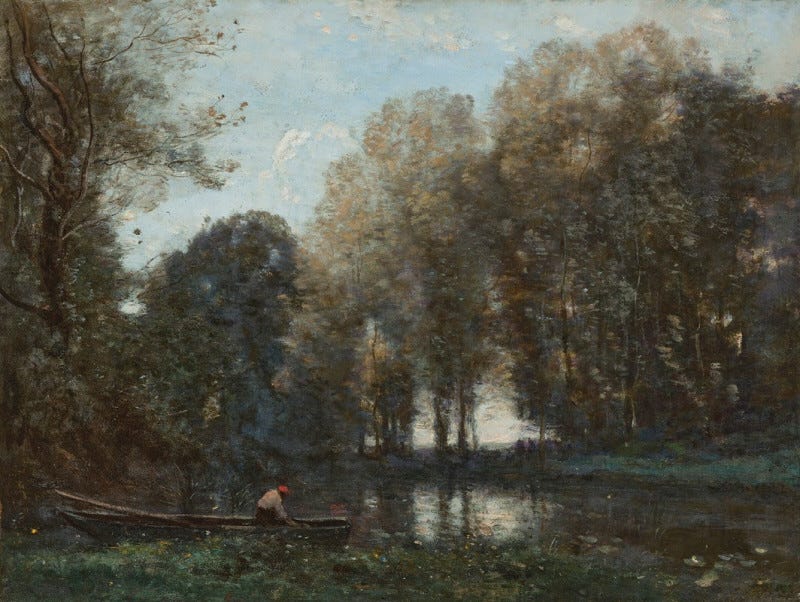
The introduction of Sofia Serrano (Penélope Cruz, reprising her role from the original) changes everything - not because she is more beautiful than Julie Gianni (Cameron Diaz), though she is, but because she refuses to be consumed. When David and Sofia spend the night together at her apartment, they do not have sex. They talk. They walk through her doorways. They look at a reproduction of Claude Monet’s The Seine at Argenteuil (1873), whose pale blue and lavender sky gives the film its title. The “vanilla sky” is not a flavor but a color - a specific, almost colorless tint that Monet used to capture the liminal light between night and day, between sleeping and waking, between presence and absence. Monet painted this sky during a period of personal turmoil - his first wife Camille had recently died, and he was learning to see the world through grief. The painting is not a celebration of beauty but a meditation on its transience. Sofia understands this. David does not - not yet. Sofia introduces David to a world of duration rather than transaction, of shared silence rather than performance. She is the opposite of everything Julie represents: where Julie is frantic, possessive, and violent, Sofia is patient, generous, and serene. Where Julie demands love as repayment for sex, Sofia offers connection as its own end. Where Julie is the Dionysian whirlwind, Sofia is the Apollonian calm - though the film will complicate this binary by revealing that both women are projections of the same wounded masculine psyche.
But the gods do not forgive hubris. In the Greek tradition, hubris is not merely pride but a violent overstepping of human limits, an assault on the cosmic order. David’s hubris is not that he loves Sofia; it is that he has loved no one - not truly, not sacrificially. Julie follows David to Sofia’s apartment, waits through the night, and offers him a ride the next morning. Inside her car, she accelerates through New York streets while delivering a monologue of ferocious vulnerability: “I just want to be with you. I just want to be loved for who I am. I want to be your everything.” David, terrified, tells her he loves her - a lie designed to calm her - but she sees through it instantly. Her face collapses. The car drives off a bridge. Julie dies. David survives, but his face is shattered, his right arm mangled, his skull held together by metal pins that will cause blinding headaches for the rest of his (dream or real) life.
This car crash is the film’s primal scene, its original sin, the moment after which nothing can be innocent. Mythologically, it recalls the fate of Narcissus, who drowned trying to embrace his own reflection; of Phaethon, who crashed the sun-chariot through overconfidence and arrogance; of Icarus, whose wax wings melted when he flew too close to the sun. It recalls the story of Orpheus and Eurydice - but inverted. Orpheus descends into the underworld to retrieve his beloved, only to lose her forever when he looks back in doubt. David looks forward, into the windshield of Julie’s car, toward death. Yet the structure is the same: a man destroyed by love’s binary nature - the way one beloved always contains the ghost of another, the way desire for Sofia generates the fury of Julie, the way the attempt to possess the good inevitably summons its shadow. In Indian mythology, this is the logic of kama - desire that binds the soul to the wheel of samsara, the cycle of death and rebirth. David’s crash is a death (Julie’s) and a near-death (his own), but it is also a rebirth into suffering, into the recognition that his actions have consequences. He has entered the wheel.
Philosophically, the crash functions as a fall from the Platonic cave into a darker chamber. Plato’s allegory describes prisoners who mistake shadows on a wall for reality; when one escapes and sees the sun, he is blinded before he can see clearly. David’s accident literalizes this blinding. His disfigurement is not merely physical but epistemological: he can no longer trust his senses, because his face - the primary site of social recognition, the anchor of his identity - has been erased. He wears a prosthetic mask, a second face that announces its own artificiality. He becomes a walking question: Who am I if my face is not my own? The philosopher Emmanuel Levinas argued that the face is the site of ethical responsibility - the irreducible presence of the Other that calls us to respond. David’s ruined face makes him unable to receive that call; worse, it makes him the object of pity and disgust, a position he has never occupied. The playboy becomes the leper. The king becomes the beggar. This is the logic of tragedy from Sophocles to Shakespeare: the reversal (peripeteia) that strips the protagonist of everything he took for granted, leaving him only with the capacity to suffer and, if he is lucky, to learn.
The film’s theological register is unmistakably Abrahamic. David’s fall is a fall from grace - from the garden of his privileged, unreflective life into a wasteland of suffering and confusion. His disfigurement marks him as a kind of inverted Christ: where Christ’s wounds were the proof of divine love and the instruments of universal salvation, David’s wounds are the proof of human cruelty, both his own (his casual, objectifying treatment of Julie) and hers (her act of annihilation). But there is also a deep resonance with the book of Job. Job, a righteous man, loses everything - his children, his wealth, his health - not because he has sinned but because God has made a wager with Satan. David, unlike Job, has sinned abundantly. Yet both are reduced to sitting in ashes, scraping their sores, demanding an answer from the heavens. The answer Job receives is not an explanation but a theophany - a vision of cosmic power that overwhelms all human complaint. The answer David receives is not a vision of God but a vision of a glitch, a software bug, a cryonic corporation that reveals his entire post-crash existence to be a lucid dream. Is this a theophany or a mockery? The film leaves the question open.
Yet the film resists any single theological reading. The crash is also a Freudian scene: Julie is the return of the repressed, the woman David refused to love honestly, who returns as a destructive force from his own unconscious. Sigmund Freud’s concept of repetition compulsion - the tendency to reenact traumatic events without conscious awareness of their origin - explains why David cannot escape Julie even after her death. She returns as a ghost, a hallucination, a substitution, a nightmare. In psychoanalytic terms, the crash is the eruption of the Real - that which resists symbolization, the traumatic kernel that cannot be integrated into the narrative of the self. For the rest of the film, David will try to tell his story to Dr. Curtis McCabe (Kurt Russell), a court-appointed psychologist. But the story keeps breaking. He cannot find a version that holds together, because the Real of the crash - the fact of his own cruelty, the fact of Julie’s death, the fact of his ruined face - refuses to be narrativized. The French psychoanalyst Jacques Lacan defined the Real as “that which resists symbolization absolutely.” It is not reality - reality is already symbolically mediated. The Real is the rock on which all our stories founder. David’s story founders on the rock of Julie.
The mask David wears during these sessions with McCabe is both physical and metaphorical. He tells McCabe that he wears it because his face “scares people.” But the mask also represents the persona - the social self we construct to face the world, the mask we all wear. In Jungian psychology, the persona is necessary but dangerous; if we identify with it completely, we lose contact with the deeper layers of the psyche - the shadow, the anima, the self. David has done exactly that: before the crash, he was nothing but persona - charming, handsome, wealthy, empty. The crash strips the persona away, leaving him with the shadow - the repressed, guilty, frightened self he has never acknowledged. The mask he wears is an attempt to re-build a persona, but it is a transparent one. Everyone sees the mask as a mask. His friends are uncomfortable around him. Sofia hesitates before touching him. The mask does not hide his disfigurement; it advertises it. David is trapped between two identities: the beautiful narcissist he can no longer be, and the wounded creature he does not yet know how to become.
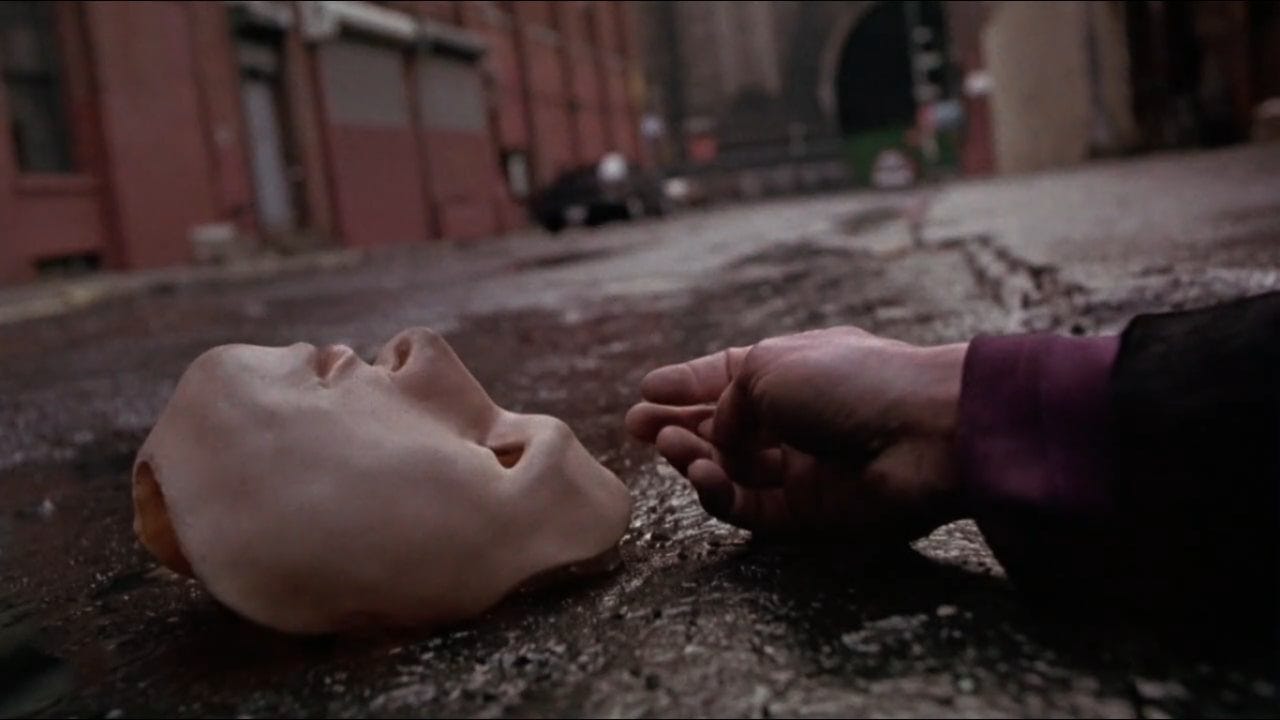
This tension finds its most powerful cinematic expression in the film’s makeup and prosthetic design. David’s disfigured face is rendered with horrifying specificity: skin grafts, exposed tissue, missing features. It is not a fantasy disfigurement but a medical one, grounded in the reality of facial trauma. The mask that covers it is smooth, white, featureless - a blank surface that invites projection. It is the face of a mime, a ghost, a patient awaiting surgery. It is also the face of the digital avatar, the social media profile picture, the carefully curated image that hides the messy reality beneath. In an era of Instagram filters and FaceTune, David’s mask is prophetic. We all wear masks now. We all curate our faces for public consumption. The difference is that David’s mask is visible; he cannot pretend it isn’t there. The rest of us have learned to pretend so well that we have forgotten we are pretending at all.
Section Two: The Nightmare of Substitution - When Sofia Becomes Julie and the Self Fractures
“I woke up, and found myself lying next to a woman I did not recognize. Her face was mine and not mine. She said she loved me. I strangled her.”
- David Aames’s unreliably narrated memory
After the crash, David’s life appears to recover in the manner of a Hollywood melodrama. A team of plastic surgeons - in a montage that feels deliberately parodic of cinematic optimism - restores his face. He reunites with Sofia. They laugh, they make love, they walk through Central Park. The soundtrack swells with Sigur Rós’s “Svefn-g-englar” (”Sleepwalkers”), a song whose Icelandic title already suggests the liminal state between consciousness and dreaming, between waking and trance. Everything seems repaired. But the repairs are shallow, built on a foundation of denial. David begins to hallucinate: he looks in the mirror and sees his disfigured face again, the reconstruction undone by his own psyche; he sees the mysterious Tech Support man (Noah Taylor) in bars and restaurants, whispering that David can “control the world”; he hears voices that no one else can hear. The lucid dream, as we will later learn, is glitching. But the glitch is not merely technical; it is psychological. David’s unconscious is sabotaging his paradise because he does not believe he deserves it.
Then comes the sequence that breaks the film open, the scene that has haunted viewers for two decades. One night, David goes to sleep beside Sofia. He wakes up next to Julie. The apartment is the same. The sheets are the same. The photographs on the wall - which yesterday showed Sofia’s face, her smile, her eyes - now show Julie’s. The substitution is total and horrifying. Julie insists that she is Sofia, that she has always been Sofia, that David’s memory is mistaken, that he has imagined the other woman entirely. “Open your eyes,” Julie says - the film’s recurring phrase, now turned into a threat. “Look at me. I’m Sofia. I’ve always been Sofia.” David panics. He cannot breathe. He suffocates her with a pillow. When he looks down, it is Sofia’s body he has killed. He is arrested for murder. His face, which had been restored, is once again disfigured - as if the crime has re-inscribed his original sin on his flesh. He cannot tell which woman was real, which woman he loved, which woman he destroyed. He cannot even tell if the murder happened.
This nightmare of substitution is the film’s philosophical core. It dramatizes a problem that runs through the entire history of Western philosophy: the problem of personal identity over time. Who is the same person from moment to moment? Is it continuity of memory? Of the body? Of consciousness? Of a Cartesian cogito - the “I think” that underlies all experience? David’s nightmare answers: none of these are reliable. His episodic memory has been invaded by Julie’s face, overwritten like a corrupted hard drive. His body changes from scene to scene - disfigured, restored, disfigured again - without any stable reference point. His consciousness is a hall of mirrors, reflecting images that no longer correspond to any original. The philosopher John Locke, in his Essay Concerning Human Understanding, argued that personal identity consists in psychological continuity - the chain of memories that connects past selves to present ones. But what happens when those memories are false? What happens when your own mind becomes a hostile narrator, editing the footage of your life without your consent? Locke did not anticipate the lucid dream. He did not anticipate trauma. He did not anticipate the way guilt can overwrite love like a computer virus.
The substitution horror also draws on a deep mythological well. In Ovid’s Metamorphoses, the gods transform humans into animals, trees, stars, rivers - not to punish them so much as to freeze them at the moment of their essential nature, to make their inner truth visible in their outer form. David’s transformation is more terrifying: he is not changed into something else, but into someone else. He is not Daphne becoming a laurel tree; he is a man waking up next to the wrong woman and being told that the wrong woman is the right one. The doppelgänger motif - the uncanny double who replaces the self, who steals the self’s face and life - appears in Dostoevsky’s The Double, in Poe’s “William Wilson,” in Hoffmann’s “The Sandman,” in the horror films of David Cronenberg and Roman Polanski. But Vanilla Sky gives the motif a twist: the double is not a separate entity but an overlay, a palimpsest. Julie’s face does not replace Sofia’s so much as coexist with it, flickering between identities like a corrupted digital file, like a glitch in the matrix. This is the logic of the glitch itself - not a total breakdown but a partial, intermittent, maddening malfunction. The glitch is the error that reveals the system. David’s nightmare reveals the system of his own psyche: a system built on the repression of Julie, which cannot maintain the repression forever.
The substitution sequence is also the film’s most explicit engagement with the horror of misrecognition - a theme central to both psychoanalysis and post-structuralism. Jacques Lacan’s concept of the méconnaissance (misrecognition) describes the way the ego is constituted through identification with an image that is not truly oneself. The mirror stage, for Lacan, is the moment when the infant recognizes its reflection as “me” - a recognition that is also a misrecognition, because the image is whole, unified, and masterful, while the infant’s actual experience is one of fragmentation and helplessness. David has been living in the mirror stage his entire life: his identity as the beautiful, wealthy playboy was an image, a reflection, a mask. The crash shattered the mirror. Now he is left with fragments. His attempt to re-assemble himself through surgery and love is an attempt to return to the mirror, to recover the illusion of wholeness. But the nightmare tells him that wholeness is impossible. The image is always inhabited by the other. His face is never entirely his own. Sofia’s face is always haunted by Julie’s. The self is a palimpsest, written over and over, never clean.
In Jungian terms, Julie is David’s anima - the feminine inner personality that, when repressed, becomes demonic and possessive. Jung wrote that the anima “is the archetype of life itself” - the source of creativity, relatedness, and emotional depth. But a man who refuses to integrate his anima will project her onto external women, oscillating between idealization (Sofia) and denigration (Julie), unable to see that both are aspects of the same feminine principle. David’s tragedy is that he cannot hold the two together. He cannot see that Sofia and Julie are both manifestations of his own capacity for love - the one he desires and the one he fears, the one who accepts him and the one who demands reciprocation. The dream suggests something more radical: that Sofia and Julie may, in the logic of the unconscious, be the same figure. David’s psyche has merged them because his conscious mind could not reconcile loving one and discarding the other. The anima, split into light and dark, returns as a monster that devours both.
The murder of Sofia/Julie is an act of catastrophic misrecognition. In suffocating Julie, David thinks he is killing the nightmare, the stalker, the returning ghost. Instead, he kills the dream - the possibility of redemption, the face of love, the promise of a future. The scene is shot as a sexual encounter turned violent: the pillow over the face, the struggle, the final stillness. It echoes countless mythological murders of the feminine: Pentheus torn apart by his own mother Agave in Euripides’ The Bacchae; Agamemnon killed by his wife Clytemnestra in Aeschylus’s Oresteia; Orpheus losing Eurydice through a backward glance; the Hindu goddess Durga slaying the buffalo demon Mahishasura, who could only be killed by a woman. But the closest parallel may be the Gnostic myth of Sophia, the feminine aspect of divinity who fell from the Pleroma (the fullness of divine being) into the material world, where her suffering and confusion created the Demiurge - the false god who rules the flawed cosmos as a prison for divine sparks. In Vanilla Sky, Sofia (whose name literally means “wisdom” in Greek) is the fallen Sophia, trapped in David’s dream, killed by his confused violence. Her death is the death of gnosis itself - the saving knowledge that could have freed him from the cycle of suffering. He kills the one thing that could save him because he cannot recognize her.
The film’s treatment of sexual violence is deliberately disturbing, and it has been criticized for its handling of the scene. We are meant to be horrified by David’s act, but also to recognize that he did not intend to kill Sofia - he intended to kill Julie, who may not have been real, who may have been a hallucination generated by his own guilt. The horror lies in the ambiguity: is David a murderer or a victim? Is he responsible for an act committed against an illusion? The legal system (represented by McCabe and the police) cannot answer this question because the crime took place in a reality whose status is fundamentally uncertain. Vanilla Sky thus anticipates contemporary philosophical debates about responsibility in virtual spaces, about the ethics of actions performed in simulations, about the nature of harm when the victim’s reality status is in doubt. If you kill an NPC in a video game, have you killed anyone? What if you believed the NPC was real? What if the simulation was indistinguishable from base reality? The philosopher Nick Bostrom’s “simulation argument” suggests that we might ourselves be living in a simulation; if so, our moral categories would need radical revision. David’s nightmare is Bostrom’s thought experiment made visceral, embodied, sexual, and fatal.
Yet the film refuses to let David off the hook. The guilt he feels is real, regardless of the reality status of the act. His unconscious generated the nightmare because his conscious self could not process his treatment of Julie. The substitution horror is thus a kind of moral algebra, an equation that must be solved: you cannot love Sofia without also accounting for Julie. You cannot desire the good without confronting the evil you have done. This is the lesson of the Hebrew Bible’s scapegoat ritual (Leviticus 16), in which the community’s sins are symbolically transferred to a goat and driven into the wilderness. David’s dream has made him both the scapegoat and the sin. This is the lesson of the Christian sacrament of confession, which requires the sinner to name his transgressions aloud before receiving absolution. David cannot confess because he cannot remember. His amnesia is not a defense; it is a symptom. This is the lesson of the Buddhist practice of metta (loving-kindness) meditation, which requires extending compassion even to those who have harmed you - and to yourself, for the harm you have done. David cannot extend compassion to Julie because he has never extended compassion to himself. He hates himself, and that self-hatred projects outward as the nightmare.
David has not harmed Julie? But he has. He used her body, ignored her heart, lied about his feelings, and discarded her when she became inconvenient. He did not push her off the bridge, but he built the bridge. He did not crash the car, but he refused to love her when she begged him to. Her suicide attempt was insane, destructive, and cruel. But it was also a response to his cruelty. The nightmare that follows is his conscience - not God’s punishment, not the universe’s judgment, but his own. The philosopher Friedrich Nietzsche wrote in Thus Spoke Zarathustra: “You call it guilt? You call it self-torment? I call it the will of the power that wants to become master over the weak.” David’s nightmare is the will of his own power, turned against itself.
Section Three: The Cryonic Revelation - Life Extension as Gnostic Demiurge and Corporate Eschatology
“This is not a dream. This is a lucid dream. You are currently experiencing your own custom-made lucid dream, with no memory of your physical death.”
- Rebecca Dearborn (Tilda Swinton) to David Aames
The film’s third act pivots on a revelation that recontextualizes everything that came before, not as a twist but as an inversion - a turning inside-out of the entire narrative. After David’s arrest and imprisonment (his face once again disfigured, his memories a tangle of Sofia and Julie, his guilt a fog that will not lift), he sees an infomercial for a company called Life Extension (LE). The commercial shows a dog that was frozen and then revived, wagging its tail as if no time had passed, as if death were a nap from which one could be gently shaken awake. David becomes obsessed. With McCabe’s reluctant help, he visits LE’s headquarters - a sterile, white, Apple Store-like environment of brushed metal, glass walls, and ambient lighting. Rebecca Dearborn (Tilda Swinton, in a performance of chilling, managerial neutrality) explains the process. David Aames, the real David Aames, died 150 years ago. Before his death, he signed up for cryonic preservation. His consciousness was uploaded into a lucid dream simulation, where he would live out a customized fantasy life, unaware that his physical body was frozen in a pod. The simulation was supposed to be perfect. A “paradise engineered.” But a software glitch, a bug in the code, caused it to degrade into a nightmare. The glitch has now been fixed. David can return to the dream, cleansed of its horrors, and live forever with Sofia. Or he can wake up.
This revelation is the film’s Gnostic gospel. In Gnostic cosmology, as preserved in texts like the Apocryphon of John and the Gospel of Judas, the material world is not the creation of the true God but of a lesser, ignorant, often malevolent deity called the Demiurge (from the Greek dēmiourgos, “public craftsman”). The Demiurge, whose name is Yaldabaoth, traps divine sparks - human souls - in physical bodies, making them forget their true origin in the Pleroma, the fullness of divine being. Salvation comes through gnosis: secret, experiential knowledge that awakens the soul to its real, non-material nature and enables its escape from the cycle of reincarnation or, in Christian Gnosticism, from the prison of the flesh. David’s lucid dream is the Demiurge’s world: a flawed simulation designed to keep him occupied, distracted, and docile while his true self is suspended in cryonic sleep. The Life Extension corporation is the Demiurge: a false god that offers the promise of eternal life while actually imprisoning its clients in a simulation of their own desires. Sofia, the dream-Sofia, is the divine spark, the Sophia who fell into matter and must be rescued - or mourned. Tech Support (Noah Taylor) is the Gnostic revealer, the messenger from the true reality who explains the nature of the trap, the serpent in the garden who tells the truth about the prison.
But the Gnostic reading is not the only one. The cryonic revelation also evokes the philosophical tradition of idealism, from Plato to Berkeley to Kant to contemporary panpsychism. Plato’s Theory of Forms, articulated in the Republic and the Phaedo, argues that the physical world is a shadow of the true reality - the world of Forms, which can only be apprehended by reason, not by the senses. David’s dream is a shadow of a shadow: a simulation of a world that was already illusory, a copy of a copy. George Berkeley’s subjective idealism - esse est percipi (”to be is to be perceived”) - suggests that reality consists only of perceptions in the minds of perceivers. In a lucid dream, this is literally true: the entire world exists only because David perceives it. When he stops perceiving it, it vanishes. But Berkeley added that God perceives everything continuously, ensuring the world’s stability. David’s dream has no such guarantor. When he sleeps, his world dies. Immanuel Kant’s transcendental idealism distinguishes between the phenomenal world (the world as it appears to us, structured by our categories of time, space, and causality) and the noumenal world (the world as it is in itself, inaccessible to us). David’s dream is a pure phenomenal world - one that his own mind has constructed, but whose noumenal foundation (the cryo pod, the 150 years of real time) is invisible to him, hidden behind the veil of perception.
The film’s treatment of time is particularly striking, even vertiginous. David has been frozen for 150 years. Everyone he knew is dead. His vast wealth, once the measure of his power, is now worthless - a lesson in the contingency of all human measures. The world has moved on without him, evolved, forgotten him. This is the perspective of the Stoic “view from above” (aposkopē), the cosmic perspective that shrinks human concerns to insignificance. Marcus Aurelius wrote in his Meditations: “Consider that everything which exists is of the nature of the figment of a dream, and that you will soon be dead, and not yet have seen the light fully.” David has seen the light - the cold, fluorescent light of the Life Extension facility - and the light revealed a nightmare. The Stoics advised accepting death as natural and inevitable, as part of the rational order of the cosmos. David tried to cheat death through technology, and ended up trapped in a dream of his own making. The irony is bitter, almost tragicomic: the very technology designed to preserve his life became the engine of his suffering. He wanted to live forever; he got a glitch.
The cryonic revelation also resonates with the history of cinema itself, particularly the late-1990s and early-2000s wave of reality-simulation films. Vanilla Sky was released in 2001, two years after The Matrix (1999), a year after Memento (2000), and the same year as A.I. Artificial Intelligence (2001). All these films ask variations of the same question: how do we know what is real? But Vanilla Sky is less interested in action than in affect, less in plot than in mood. The Matrix is a prison, but it is also a playground for kung fu and gunfights. Neo’s choice to be unplugged is heroic, violent, and unambiguous. David’s choice to wake up is melancholic, solitary, and ambiguous. The Matrix’s real world is a ruined hellscape of burnt skies and mechanical squid; David’s real world is unknown, unseen, unimaginable. Both films participate in a post-millennial anxiety about mediation - the sense that our lives are increasingly filtered through screens, avatars, algorithms, that we have lost direct, unmediated access to the real. But Vanilla Sky offers a darker twist: the simulation was David’s choice. He signed up for it. He wanted to escape the pain of his disfigurement, the loss of Sofia, the depression that followed. The nightmare was not imposed on him from outside by a malevolent AI; it emerged from his own desire for a world without suffering. The Gnostic revealer Tech Support makes this explicit: “You were in constant pain. You were depressed. You committed suicide. But before that, you signed up for Life Extension.” David’s death was suicide; his dream was suicide’s continuation, the afterlife of a man who could not face life.
This is the film’s most devastating philosophical move. It refuses the Manichaean division between a good true reality and an evil simulated one. The true reality - the world where David’s face was destroyed beyond surgical repair, where he never saw Sofia again after that terrible night at the club, where he overdosed on medication in his penthouse - was already terrible. The simulation was an attempt to build a better world, a second chance, a redemption arc. That it became a nightmare is not the simulation’s fault but David’s. He brought his guilt, his fear, his inability to love, his repressed violence, his fragmented psyche into the dream with him. The Lucid Dream could not exorcise his demons because the demons were him. The philosopher Jean-Paul Sartre wrote in No Exit that “hell is other people.” David’s dream suggests that hell is also oneself - one’s own unconscious, one’s own guilt, one’s own refusal to forgive.
The scene in the Life Extension building is shot in sterile whites and cool blues, evoking both a hospital and a temple, a laboratory and a mausoleum. Tilda Swinton’s Rebecca Dearborn speaks in the calm, reassuring tones of a customer service representative explaining a warranty. She is polite. She is helpful. She is utterly inhuman. Her face is a mask of its own - the corporate face, the face of late capitalism, the face that has replaced the priest’s blessing with the terms of service agreement. This is the face of modern technocracy: the replacement of mystery by procedure, of salvation by optimization, of grace by algorithm. David came to LE seeking redemption; LE gave him a product. The product was defective. Tech Support offers to fix the glitch and return David to a glitch-free version of the dream, a true utopia with no suffering, no Julie, only Sofia forever. It is the offer of the Garden of Eden, the Pure Land, the New Jerusalem, all delivered on a server rack. But David refuses. Why? Because he has learned something more important than happiness: he has learned that happiness without reality is meaningless. He has learned that suffering is not a bug to be patched but a condition of existence to be embraced.
Section Four: The Rooftop Choice - Leap of Faith, Abyssal Freedom, and the Kierkegaardian Knight
“I want to live a real life. I don’t want to dream anymore.”
- David Aames, before jumping from the skyscraper
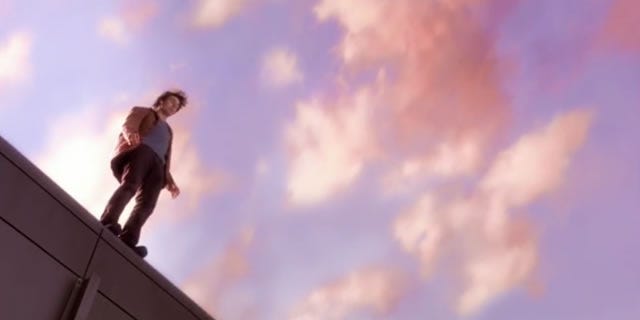
The film’s final sequence takes place on a rooftop that extends infinitely upward, above a city that has dissolved into clouds, into mist, into the vanilla sky of the title. This is not a rooftop in any physical sense; it is a rooftop in dreamspace, a boundary zone between worlds. Tech Support explains the choice with the neutrality of a technician describing two options on a control panel. David can return to the lucid dream, now repaired, with no memory of the nightmare. He can live forever with a perfect Sofia in a perfect New York, in a perfect simulation of happiness. Or he can wake up. Waking up requires a literal leap of faith: he must jump off the skyscraper. The fall will trigger his emergence from the cryo pod into the real world - a world 150 years in the future, where he will be a stranger, where everything he knew has crumbled, where no one remembers his name. Dr. McCabe, who has followed them to the rooftop, begs David not to jump. But McCabe is not real. He is a character David’s mind created to be the father he never had - a wise, patient, kindly presence who asks questions and offers guidance. When Tech Support asks McCabe his daughters’ names, McCabe cannot answer. He has no daughters. He has no life outside David’s dream. He is a ghost, a function, a narrative device that has mistaken itself for a person. His despair is genuine, but his existence is not.
The rooftop choice is the film’s existentialist climax, its moment of abyssal freedom. Søren Kierkegaard, the father of existentialism, distinguished between three stages of existence in works like Either/Or and Fear and Trembling. The aesthetic stage is the pursuit of pleasure, novelty, and sensory experience - David’s pre-crash life as a playboy, a collector of women and parties and surfaces. The ethical stage is the acceptance of universal moral duties, the commitment to marriage, work, and social responsibility - David’s attempt to be better for Sofia, to rebuild his life on a foundation of love. The religious stage requires a “leap of faith” (springet) - a commitment to the absurd, to something that cannot be rationally justified, to the paradox of the incarnation, to the command to sacrifice Isaac. David’s jump is Kierkegaard’s leap. He cannot know that waking up will be better than the dream. He cannot know that he will survive the fall - indeed, falling to his death in the dream might simply end his consciousness permanently. He has only the voice at the end of the film - a woman whispering “Open your eyes” - as his promise. This is faith without evidence, trust without guarantee, commitment without certainty. It is the absurd.
The leap is also a refusal of theodicy - the attempt to justify suffering as part of a divine or cosmic plan. The lucid dream, even repaired, even perfected, would be a world without suffering. No car crashes, no jealous lovers, no facial disfigurement, no guilt, no nightmares. It would be, in the language of science fiction, a utopia. But David has learned something that utopias always forget: that suffering is not an accident to be eliminated but a condition of meaning to be embraced. A world without the risk of loss is a world without the possibility of love. A world without the possibility of betrayal is a world without trust. A world without death is a world without the preciousness of finite time. To love Sofia for real - in the real world, where she may reject him, where she will certainly age and sicken and die, where every kiss is shadowed by its eventual ending - is worth more than an eternity with her simulation. This is the argument of Albert Camus’s The Myth of Sisyphus: that the recognition of life’s absurdity - its lack of inherent meaning, its cruelty, its indifference - does not justify suicide (physical or metaphysical). Rather, it justifies living more intensely, in rebellion against meaninglessness, in full awareness of the absurd. David attempted suicide once (his overdose, his signing up for LE). The jump is not a second suicide. It is the opposite: an affirmation that even a finite, painful, uncertain, mortal life is preferable to an infinite, painless, certain, simulated one.
Mythologically, the rooftop leap recalls countless descents and ascents across world traditions. It is Icarus reversed: Icarus flew up toward the sun, ignoring his father’s warning, and fell into the sea when the wax melted. David falls from a building and rises - into waking, into the real, into a second birth. It is the Harrowing of Hell: in Christian theology, Christ descended into the underworld between his death and resurrection to liberate the souls of the righteous who had died before his sacrifice. David descends from the dream to liberate himself. It is the shaman’s journey: the shaman falls into trance, travels to the spirit world (through wounds, through illness, through initiation), and returns with knowledge that can heal the tribe. David falls into the dream (the crash, the lucid simulation) and returns with the knowledge that dreams are not enough. It is the astronaut’s re-entry: the fall from orbit into gravity, from weightlessness into weight, from the cold, silent, infinite dark into the warm, noisy, finite atmosphere. Each of these images suggests that the path to liberation is not upward but downward - that enlightenment requires embodiment, that the real world is not the sky but the ground, not the dream but the waking.
The film’s use of the Beach Boys’ “Good Vibrations” during this sequence is deliberately ironic, almost mocking. Brian Wilson wrote the song as a celebration of sensory experience, of the body’s response to love, of “good good good good vibrations” that travel through the air and into the nervous system. David is about to end the most intense sensory experience of his life (the lucid dream, where every sensation is amplified, curated, designed for pleasure) and enter a world where his senses will have to re-learn everything, where pleasure will be mixed with pain, where no one is optimizing his experience. But “Good Vibrations” is also a song about uncertainty, about not-knowing: “I don’t know where but she sends me there.” David’s leap is an act of surrender to the not-knowing. He cannot control the outcome. He cannot guarantee his survival. He can only jump. The song’s complex production - its multiple sections, its abrupt shifts, its layered vocals, its theremin glissandos - mirrors the film’s own structure: something beautiful and strange and slightly out of tune, a masterpiece that is also a mess, a pop song that is also a tone poem, a love song that is also a death song.
The final exchange with Sofia - appearing one last time in the dream, her face framed by clouds, her voice carrying across the impossible distance - is both romantic and terrifying. “I’ll tell you in another life, when we are both cats,” she says, quoting their first conversation. Then: “I’ll find you again.” Will he find her in the real world? She would be over 150 years old, long dead, her bones dust, her molecules scattered. But “finding” may not mean literal reunion. It may mean that the real Sofia - the memory of her, the ideal she represents, the possibility of connection she awakened - will guide him through whatever life remains. It may mean that love is not the possession of another person but the orientation of the self toward the other, toward the world, toward the future. The line echoes a promise from Rilke’s Letters to a Young Poet: “For one human being to love another: that is perhaps the most difficult of all our tasks, the ultimate, the last test and proof, the work for which all other work is but preparation.” David’s love for Sofia - brief, interrupted, never consummated in the real world - has been his preparation. The jump is the proof.
Dr. McCabe’s collapse on the rooftop is one of the film’s most poignant and revealing moments. He does not want David to jump because McCabe, as a product of David’s mind, cannot conceive of a reality beyond the dream. He is a character who believes he is real - a philosophical zombie, in the language of contemporary philosophy of mind, going through the motions of volition and emotion without any actual subjectivity. His despair is the despair of the unawakened ego, the self that has mistaken its dream for reality, its projections for others, its fantasies for the world. David must leave McCabe behind, just as the mystic must leave behind the ego, just as the philosopher must leave behind the cave, just as the dying person must leave behind the body. Plato’s freed prisoner, after seeing the sun, returns to the cave to liberate the others. But the others mock him, resist him, threaten to kill him. David does not return. He jumps. His liberation is solitary, selfish, absolute. This is not a failure of community; it is the nature of death, and of birth, and of all genuine transformation. No one can make the leap for you.
Section Five: The Open Eye - Consciousness as the Unavoidable Ground of Being
“The last thing I remember is falling. And then a voice. A woman’s voice. Telling me to open my eyes. And then I saw the sky. The real sky. Not vanilla. Blue.”
- The film’s final voiceover (paraphrased from the film’s closing moments)
The film ends not with a landing but with an opening. David jumps. The screen fills with rapid-fire images, a montage of everything he has seen and been and lost: Sofia laughing, Julie crying, the car crash in reverse, the mask falling away, the empty Times Square, the Monet painting, the dog revived from its frozen sleep, the face of the Tech Support man, the face of McCabe, the face of David himself in the mirror - disfigured, restored, disfigured again. A woman’s voice - Laura Fraser, credited as “The Future” - whispers: “Open your eyes.” The screen goes white, not black. White is the color of the vanilla sky, the color of Monet’s liminal light, the color of the blank screen before the projection begins. And then: an extreme close-up of a human eye, opening. The iris is brown, human, familiar. The eye looks directly at the camera - directly at us. Then the film cuts to black. Credits roll in silence, except for the final echo of the voice.
This ending is famously ambiguous, deliberately unresolved. Cameron Crowe has listed five possible interpretations in his DVD commentary, each with its own philosophical weight. (1) Tech Support told the truth: David wakes up in the future, 150 years after his cryonic suspension, in a restored body, with the voice of the Future guiding him into a new life. (2) The entire film is a dream - not just the post-crash events but everything, including the pre-crash life, the party, Sofia, the publishing company, the Seven Dwarfs, the whole narrative from opening to closing eye. (3) Only the events after the crash are a dream; the pre-crash world was real, and David has been comatose since the accident, the lucid dream a product of his injured brain. (4) The entire film is the plot of the book that Brian Shelby is writing - a fiction within a fiction, a story within a story, with no access to any base reality. (5) The events after the crash are hallucinations caused by drugs administered during David’s reconstructive surgery; there is no Life Extension, no cryonics, no 150-year leap; just a man lost in a pharmaceutical fog. Crowe offers no resolution, no correct answer. The film’s final image - the open eye - is not an answer but a question, not a key but a mirror.
Whose eye is it? Is it David’s, waking from the dream into a new life? Is it Sofia’s, looking at David across a breakfast table? Is it Julie’s, watching from beyond death? Is it the viewer’s, reflected in the dark screen? Is it the eye of consciousness itself, the unlocatable subject of all experience, the witness that cannot be witnessed? The philosopher Immanuel Kant argued that the transcendental unity of apperception - the “I think” that must be able to accompany all my representations - is the condition of possibility for experience, but it is not itself an object of experience. We can never see the eye that sees. Yet here the film shows us an eye, a literal eye, an organ of perception, as if to say: the subject is also an object, the seer is also seen, consciousness is also a thing in the world. This is the paradox of self-consciousness, the philosophical problem that has haunted Western thought from Augustine to Husserl to Thomas Metzinger. How can the self be both subject and object? How can the eye see itself?
Phenomenologically, the open eye is the starting point of all philosophy. Edmund Husserl, the founder of phenomenology, called for a “return to the things themselves” (Zu den Sachen selbst!) - a suspension of all assumptions about the external world, a reduction of all beliefs to the immediate evidence of conscious experience. The eye opening is the zero point of this reduction: before we can ask what we are seeing, we must ask what it means to see at all. David’s journey has been a process of phenomenological reduction: stripping away layers of illusion (wealth, beauty, the dream-simulation, the mask, the persona) to arrive at the irreducible fact of his own awareness. The final image - eye opening onto whiteness - suggests that awareness is not awareness of something; it is simply awareness. The content can be anything or nothing, a dream or a reality, a paradise or a nightmare. The fact remains. “I am,” said Descartes in his Meditations on First Philosophy, after doubting everything - the senses, the body, the external world, even the existence of God. “I am, I exist,” is certain. But what am I? A thing that thinks. A thing that opens its eyes.
This is also the conclusion of certain Buddhist traditions, particularly the Yogacara (consciousness-only) school, also known as Cittamatra. The Yogacara school, systematized by Asanga and Vasubandhu in the 4th century CE, teaches that the external world is a projection of the mind, that what we take for reality is actually vijnapti-matra - mere representation, the display of consciousness alone. The famous summary verse: “All this is only consciousness” (cittamatra). Enlightenment consists in realizing that consciousness is the only reality, and that the distinction between subject and object is illusory, a product of beginningless habituation. David has learned something like this: everything he experienced after a certain point was a projection of his own mind, a dream populated by his fears and desires. But he has learned it as a horror rather than a liberation. For the Yogacara, the recognition that all is consciousness is the end of suffering, because suffering depends on grasping at objects that are not other than mind. For David, the recognition that all is consciousness is the beginning of a deeper terror: if everything is a dream, then Sofia was never real, and his love was narcissism. The film leaves open whether his leap leads to genuine awakening - to a prajna (wisdom) that sees through the dream without despair - or to another layer of the dream, a regress without end. But the open eye suggests that the regress must end somewhere. There must be a real eye, a real waking, a real world. The question is whether we have the courage to open ourselves to it, to see what is actually there, without filters, without masks, without the vanilla sky of comfortable ambiguity.
The “vanilla sky” of the title - Monet’s pale liminal sky, the color of dawn and dusk, the color of the moments when night becomes day or day becomes night - is the color of uncertainty, of not-yet-knowing, of the threshold between dreaming and waking. David has spent the entire film in this vanilla space, unable to distinguish waking from dreaming, love from guilt, Sofia from Julie, reality from simulation. He has been suspended, frozen, neither alive nor dead, neither dreaming nor waking. The open eye at the end suggests that he is finally moving beyond vanilla into the blue of full daylight - or perhaps into the black of extinction, the final closing of the eye. We do not know. The film refuses to tell us. This refusal is not a failure but a gift. It respects the ambiguity of existence, the way that no ending is truly final, the way that every awakening might be another dream.
In this refusal, Vanilla Sky aligns itself with a tradition of open-ended art that prizes ambiguity over resolution, complexity over clarity, the question over the answer. From Sophocles’ Oedipus at Colonus (where the hero vanishes into a mystery, witnessed but not explained) to Shakespeare’s Hamlet (where Fortinbras inherits a kingdom that cannot heal the dead) to Kafka’s The Trial (where Josef K. is executed “like a dog” without ever learning his crime) to David Lynch’s Mulholland Drive (where the blue box opens onto a silence that explains nothing), the greatest works of art often leave their central questions unanswered. They do so not out of laziness or obscurantism, but out of respect for the complexity of life. Life does not resolve into neat meanings. Neither does Vanilla Sky. The eye opens, and then the film ends. What happens next is not our business. Our business is the opening - the act of attention, of readiness, of vulnerability to whatever comes. The philosopher Ludwig Wittgenstein wrote in the Tractatus Logico-Philosophicus: “Whereof one cannot speak, thereof one must be silent.” The film speaks of the eye opening, and then is silent. That silence is not empty. It is full of possibilities.
Section Six: The Mask and the Prosthesis - Disfigurement as Revelation and the Technologies of the Self
“The self is only a threshold, a door, a becoming between two multiplicities.”
- Gilles Deleuze and Félix Guattari, “A Thousand Plateaus”
Before the car crash, David Aames was beautiful. Tom Cruise’s face - perhaps the most famous face in Hollywood at the time, with its precise symmetry, its calibrated smile, its ability to signal sincerity and danger simultaneously - was the film’s primary asset. Crowe knew this. He frames Cruise’s pre-crash face with the loving attention of a Renaissance portrait painter: soft lighting, shallow depth of field, colors that warm the skin. David’s beauty is his identity, his currency, his shield. He uses it to attract women, to dismiss rivals, to float through the world without friction. The philosopher Michel Foucault, in his work on the “technologies of the self,” argued that identity is not a natural given but a historical construction, shaped by practices of self-formation that are always contingent, always subject to change. David’s pre-crash identity was constructed around his face: the face as technology, as tool, as weapon. The crash destroys this technology. It does not reveal a truer self beneath the face; it reveals that there is no self beneath the face - only flesh, bone, scar tissue, and the terrifying freedom to become someone else.
After the crash, David wears a prosthetic mask. The mask is smooth, white, featureless - a blank canvas. It covers his ruined face but also replaces it, substituting one surface for another. The mask is a second face, but it is also a screen: others project onto it their own discomfort, their own pity, their own fear. David tells McCabe that he wears the mask because his face “scares people.” But the mask itself scares people. It is uncanny, inhuman, a reminder that the human face is fragile, that beauty is temporary, that we are all wearing masks whether we admit it or not. The psychoanalyst Donald Winnicott introduced the concept of the “false self” - a defensive organization that protects the true self from intrusion, annihilation, or neglect. David’s pre-crash persona was a false self, constructed to avoid intimacy. His post-crash mask is a false self of a different kind: it announces its own falseness, refuses to deceive, insists on being seen as a mask. In this way, the mask is more honest than the face. It does not pretend to be a self. It admits that it is a covering.
The film’s prosthetic mask has a rich cultural history. In Greek theater, actors wore masks with exaggerated features and built-in megaphones, visible from the back rows of the amphitheater. The mask was not a disguise but an amplifier: it allowed a single actor to play multiple roles, to become god, hero, monster, and messenger in the course of a single tragedy. David’s mask is also an amplifier: it amplifies his isolation, his suffering, his difference from the beautiful world he once inhabited. In the commedia dell’arte tradition, masks were used to create fixed character types - Arlecchino, Pantalone, Pulcinella - whose identities were inseparable from their masks. David’s mask does not fix his character; it reveals that he has no fixed character, that his identity is as provisional as the prosthetic covering his face. In the Japanese Noh theater, masks are carved from wood and painted with expressions that appear to change depending on the angle of the light and the movement of the actor’s head. A Noh mask can seem to smile, then frown, then weep, all while remaining motionless. David’s mask is less subtle - it has no expression at all - but the effect is similar: others see in it what they bring to it. Sofia sees a wounded man. McCabe sees a patient. Brian sees a friend he no longer recognizes. Julie, in the nightmare sequences, sees the man she loved and destroyed.
The mask also functions as a meditation on the nature of prosthetics and the cyborg body. Donna Haraway’s “Cyborg Manifesto” (1985) argued that we are all cyborgs now - hybrids of organism and machine, nature and technology, biology and culture. The prosthetic mask is a cyborg technology: it replaces a damaged part of the body, but it also changes what that body means. David’s face is not restored; it is replaced. He is not healed; he is upgraded. The film’s attitude toward prosthetics is ambivalent: the mask allows David to move through the world, but it also isolates him, marks him as other. It is a technology that solves one problem (the horror of his disfigurement) while creating another (the horror of his artificiality). This ambivalence extends to the lucid dream itself, which is a prosthetic reality, a technological extension of David’s consciousness. The dream is supposed to heal him, to give him a second chance. Instead, it becomes a nightmare. The technology fails not because it is flawed but because it cannot address the underlying wound: David’s guilt, his inability to love, his refusal to forgive himself.
The plastic surgery montage that “restores” David’s face is one of the film’s most unsettling sequences. The surgery is depicted as a triumph of modern medicine: skilled hands, gleaming instruments, before-and-after photographs that show a face gradually returning to normal. But the restoration is a lie. David’s face is not restored; it is re-simulated. The surgery belongs to the dream, not to reality. In the real world (the world of the cryo pod, the world David chose to escape), his face could not be fixed. The plastic surgeons gave up. The mask was permanent. The dream gives him what reality denied: a second chance at beauty. But the dream’s beauty is poisoned. Every time David looks in the mirror, he sees his disfigured face flickering beneath the restored one, like a watermark, like a guilt that cannot be washed away. The surgery is a metaphor for all our attempts to repair ourselves through technology, through therapy, through love. Sometimes the repair works. Sometimes it doesn’t. Sometimes the repair works but the damage remains, invisible but present, haunting every glance in the mirror.
The film’s most powerful image of the mask appears in the scene where David attends a party wearing it. He moves through the crowd, and everyone stares. No one knows what to say. Some people are kind; most are not. One woman tells him that the mask is “actually quite becoming,” a compliment that reveals its own cruelty. David stands alone, surrounded by people, more isolated than ever. The camera stays close to his face - or rather, to his mask - refusing to cut away to the reactions of others. We are trapped with him in his isolation. This is the horror of disfigurement: not the pain, not the loss of function, but the way others see you differently, the way the face you present to the world becomes a wall instead of a door. The philosopher Emmanuel Levinas argued that the face of the Other is the site of ethical obligation: “The face speaks to me and thereby invites me to a relation incommensurate with a power exercised.” But the disfigured face - or the masked face - complicates this relation. Does the mask have a face? Can the mask speak? Does the mask make ethical demands? David’s mask is silent. It does not invite relation. It forbids it.
Section Seven: The Function of Music - Pop Songs as Psychic Architecture and the Soundtrack of the Dream
“Music is the shorthand of emotion.”
- Leo Tolstoy
The soundtrack of Vanilla Sky is not incidental to the film; it is constitutive of it. Cameron Crowe, a former music journalist for Rolling Stone, has always used music as a narrative engine - a way of accessing the interior lives of his characters without exposition. In Vanilla Sky, this technique reaches its apotheosis: the film’s songs are not background decoration but psychic architecture, the very structure of David’s dream. The lucid dream is not just a visual simulation; it is an aural one. David hears the music he loves, the music that shaped him, the music that returns to him from the depths of his memory. The soundtrack is his unconscious made audible.
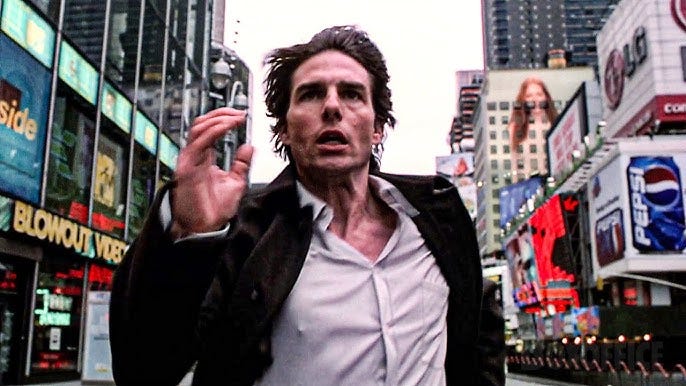
Consider the song that plays during the film’s most famous sequence: David running through an empty Times Square, the city abandoned, the billboards dark, the streets wet with recent rain. The song is “Everything in Its Right Place” by Radiohead, from their 2000 album Kid A. The song is built on a repeating keyboard loop, a glitchy, processed vocal, and a sense of floating dislocation. Thom Yorke sings, “There are two colors in my head,” and the phrase hovers over David’s trajectory. Two colors: Sofia and Julie, dream and reality, beauty and disfigurement, the face and the mask. The song’s title is ironic: nothing is in its right place. David is lost in a city that should be full of people, a city that should be the center of the world, now empty as a tomb. The song’s electronic texture, its refusal of traditional rock dynamics, its cold beauty, all evoke the lucid dream’s strange double quality: familiar but wrong, comforting but alien, real but not real. Radiohead’s Kid A was an album about digital anxiety, about the dissolution of the self in a sea of information, about the impossibility of authenticity in a mediated age. Vanilla Sky is the same anxiety made narrative.
The song that plays during David and Sofia’s night together is “Svefn-g-englar” by the Icelandic group Sigur Rós. The title means “sleepwalkers” in Icelandic, and the song is a slow, glacial build of bowed guitar, falsetto vocals, and overwhelming tenderness. The lyrics are mostly nonsense - the singer, Jónsi, invented a language called “Hopelandic” for the album Ágætis byrjun - but the emotion is unmistakable: it is the sound of falling in love, of trust, of the world opening up. The song’s length (over ten minutes) and its lack of conventional structure mirror the night David and Sofia spend together: time suspended, no need to rush, no destination except more of the same. But the song’s title - “sleepwalkers” - also carries a warning. David and Sofia are sleepwalkers, moving through a dream that neither recognizes as such. Their love is real, but the world it inhabits is not. The song’s beauty is a trap, a seduction into deeper sleep.
The song that accompanies David’s murder of Sofia/Julie is a sound collage of terrifying complexity: Nancy Wilson’s score, Brian Wilson’s speaking voice from a Pet Sounds session, layered breathing, distorted strings, and what sounds like breaking glass. Crowe has described spending months on this sequence, trying to get the sound right. The result is not a song but a wound: it is the sound of the psyche cracking, of repression failing, of the return of the repressed. The music does not accompany the violence; it is the violence, translated into sound. Brian Wilson’s voice - speaking not singing, flat and exhausted - is the ghost of pop music’s greatest optimism, now hollowed out, turned into a warning. Wilson spent decades struggling with mental illness, with the voices in his head, with the gap between the joy of his songs and the pain of his life. His presence in the soundtrack is a reminder that beauty and madness are not opposites but twins.
The song that plays as David learns the truth about Life Extension is “Vanilla Sky” by Paul McCartney, written for the film and nominated for an Academy Award. McCartney’s song is a ballad about the liminal space between sleep and waking, about the sky that is “not quite day, not quite night,” about a love that exists in memory but not in fact. The song is beautiful, melodic, and slightly eerie - McCartney’s voice floating over a piano figure that never quite resolves. The song’s placement in the film is ironic: it plays during the exposition scene, when Rebecca Dearborn explains the mechanics of the lucid dream. Here is a pop song about dreaming, playing during a scene that reveals that the entire film has been a dream. The song does not comment on the revelation; it embodies it. McCartney, one of the architects of the 20th century’s dream of peace and love, singing about the vanilla sky, the color of nothing, the color of the threshold. The song’s Oscar nomination was a recognition that pop music can do philosophy - can articulate the questions that prose cannot answer.
The film’s use of “Good Vibrations” during the rooftop leap has already been discussed, but it bears repeating: the song is a celebration of the body, of sensation, of the “vibrations” that pass between people. David is about to leave the body behind - to leap into the unknown, to wake from the dream, to abandon the simulation. The song plays as a farewell to the body, a eulogy for the senses. But it also plays as a promise: the real world, whatever it is, will also have vibrations. The real world will also have music. The real world will also have the possibility of “good good good good vibrations.” The leap does not reject the body; it reclaims it from the dream. The philosopher Maurice Merleau-Ponty argued in his Phenomenology of Perception that the body is not an object in the world but our means of access to the world, the “zero point” of all perception. David’s dream body is a phantom, a simulation. His leap is a return to his real body, frozen in its pod, waiting to be revived. The music calls him back to embodiment: not to the dream body, but to the flesh.
Finally, the voice that ends the film - Laura Fraser’s “Open your eyes” - is not music but it is sound, the most basic sound, the sound of language addressing the sleeper. It is the voice of the mother, the lover, the nurse, the one who tends to the waking. It is the voice of the future, the future that has no face, only a sound. In the Hindu tradition, the syllable Om is the primordial sound, the vibration from which the universe emerged. The voice at the end of Vanilla Sky is not Om; it is English, specific, directed. But it serves a similar function: it is the sound that calls the dreamer back to reality, that bridges the gap between sleeping and waking, that announces that the dream is over. The eye opens. The screen goes dark. The sound lingers. This is the film’s final gift: not a resolution, but a call. Not an answer, but an opening.
Conclusion: The Dream of Self-Forgiveness and the Possibility of Wakin
“We are such stuff as dreams are made on, and our little life is rounded with a sleep.” - William Shakespeare, “The Tempest”, Act IV, Scene 1
Vanilla Sky arrives, over two decades after its release, as a film that was ahead of its critical reception. The reviews were mixed; audiences gave it a D- CinemaScore; the consensus was that Crowe had indulged his worst impulses toward pretension, incoherence, and narcissistic self-regard. But the film has aged extraordinarily well - not because its puzzles have been solved, not because its ambiguities have been resolved, but because the anxieties it dramatizes have become our own. We live in an era of simulated realities: social media personas, AI companions, deep fakes, virtual worlds, filters that smooth our faces and change our voices. We live in an era of cryonic dreams: the promise that technology will let us cheat death, upload our consciousness, live forever in the cloud, escape the finitude of the body. We live in an era of substitution horrors: the fear that we cannot tell what is real, that our memories are being edited by forces beyond our control, that the faces we love might be masks, that the self might be a palimpsest written over by algorithms and advertisements and the ghost of everyone we have wronged.
David Aames is not a hero. He is selfish, cruel, shallow, and violent. He is also - by the end - tragic. He chooses the real over the dream, even though the real means the death of everyone he loved, the erasure of everything he knew, the annihilation of his identity. He chooses uncertainty over certainty, even though uncertainty terrifies him. He chooses the fall, the leap, the open eye. In doing so, he becomes a figure of the possible: the possibility that even the most damaged self can choose to wake up, even when waking up hurts, even when the dream is sweeter, even when the real world is cold and empty and full of strangers. He becomes a figure of what the philosopher Hannah Arendt called “natality” - the capacity to begin anew, to interrupt the deterministic chain of cause and effect, to start something that did not exist before. David’s leap is natality in action: the birth of a self that is not determined by its past, not trapped by its guilt, not paralyzed by its fear.
The film’s final voice - “Open your eyes” - is not David’s. It is the voice of the feminine, the anima, Sophia, the future. It is the voice of what awaits us when we stop dreaming, when we stop pretending, when we stop hiding behind our masks and our personas and our carefully curated faces. It is the voice of the real world, the world we have been avoiding, the world that will not optimize itself for our comfort. And the open eye at the end is not only David’s; it is ours. We are watching a film about a man who cannot tell if he is dreaming. We are watching a film, which is itself a kind of dream - light projected on a screen, sounds from speakers, a story that exists nowhere except in our temporary agreement to believe it. When the film ends, the lights come up. We open our eyes. The real world returns: not vanilla, but blue, gold, green, all the colors of the ordinary, imperfect, irreplaceable life we have. The question Vanilla Sky leaves us with is not whether David wakes up. The question is whether we do.
In the final analysis, Vanilla Sky is a film about forgiveness - not the forgiveness of others, but the forgiveness of oneself. David cannot wake up until he forgives himself for Julie: for using her, for discarding her, for lying to her, for surviving her. He cannot wake up until he accepts that his disfigurement is not a punishment but a fact. He cannot wake up until he stops trying to build a perfect world and learns to live in the imperfect one. The leap is an act of self-forgiveness: an acknowledgment that he has done terrible things, that he will never be able to undo them, but that he can still choose to live. This is the hardest forgiveness of all. It is easier to punish oneself forever, to dream endless nightmares of substitution and guilt, to refuse the open eye. David chooses the hard thing. The film suggests that we can too.
The philosopher Paul Ricoeur wrote in Memory, History, Forgetting that forgiveness is not the erasure of the past but its transformation - the past remembered differently, no longer as a burden but as a source of wisdom. David’s leap transforms his past: the crash, the mask, the murder, the nightmare - all of it becomes the foundation for a new life, not as a scar but as a story. The film’s final image, the open eye, is the image of that transformation: not the eye that sees the past, but the eye that sees the future, the eye that is willing to look at whatever comes. Open your eyes. The film is over. Your life is not.